
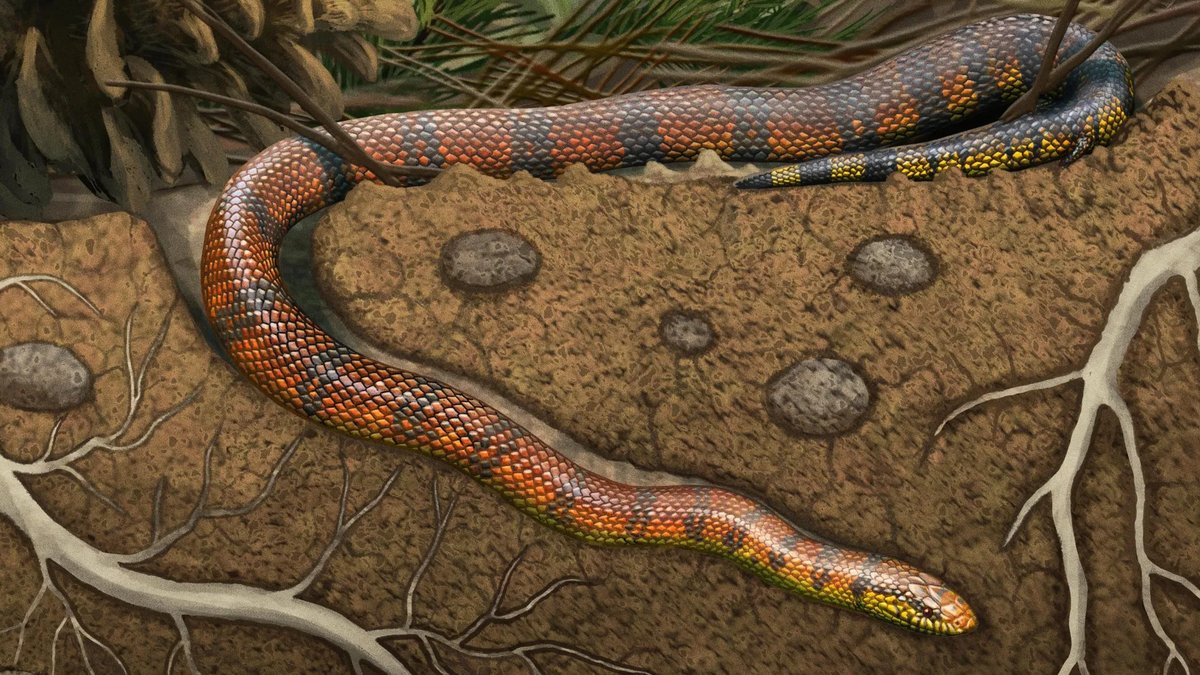
Scientists have reconstructed the brain of an 80-million-year-old snake, shedding new light on how early serpents diversified across different habitats.
Ancient fossil offers rare insight
The specimen, named Tametara mirim, comes from Late Cretaceous deposits in southeastern Brazil and represents one of the most complete fossil snake skeletons ever found. Researchers used computed tomography and cinematic 3D rendering to produce a digital model of the skull, vertebrae, and brain endocast. The detailed scans revealed anatomical features that would be difficult to assess from exposed bones alone.
Lead author Tiago Simões, an assistant professor at Princeton University, said the study shows “early snakes had already achieved remarkable ecological and morphological diversity by the Late Cretaceous, around 80 million years ago.” The work involved collaborators from the University of Helsinki’s HiLIFE Institute and the University of São Paulo.
Related: Air Pollution Linked to Rheumatoid Arthritis Flare Ups
Brain shape points to distinct lifestyles
Comparisons with another fossil snake, Dinilysia patagonica, from Argentina highlighted stark differences in brain morphology. While Tametara’s brain structure aligns with traits seen in modern burrowing snakes, Dinilysia’s anatomy resembles that of surface-dwelling species. Researchers linked these variations to divergent sensory adaptations, suggesting each lineage occupied separate ecological niches.
“The two had strikingly different brain shapes, both from each other and from most other snakes studied,” noted research director Nicolas Di‑Poï. “Brain shape and bone microstructure pointed to the same conclusion: Tametara was adapted to burrowing, Dinilysia to life on the ground.”
Evidence from marine sediments further supports the idea that early snakes moved among underground, terrestrial, and aquatic environments. The study therefore challenges the long‑standing notion that snakes followed a single evolutionary route toward limblessness.
From a broader perspective, the findings imply that early snake evolution was not a linear march toward a uniform body plan. Instead, multiple lineages appear to have experimented with different sensory systems and habitats, a pattern that may have set the stage for the extensive diversity seen among the more than 4,000 snake species alive today.
Related: Sitting too much may harm brain health
Implications for understanding snake origins
Previous debates centered on whether snakes first became elongated and limbless in subterranean or aquatic settings. The new brain data suggest a more complex scenario: early serpents likely toggled between several environments, with each transition leaving distinct neuroanatomical signatures. By integrating CT‑based brain reconstructions with data from living snakes, the team argues that the fossil record alone cannot capture the full story of snake evolution.
Simone Macrì, a postdoctoral researcher involved in the study, emphasized that “the brain tells a much richer story than the skeleton alone.” Their approach shows how modern imaging techniques can reveal functional aspects of extinct animals that were previously inaccessible.
Future work may prompt paleontologists to re‑examine other fossil snakes for similar neuroanatomical clues. If additional specimens display comparable diversity, the pattern of habitat‑driven experimentation could be reinforced, offering a more detailed view of how snakes adapted to changing Cretaceous ecosystems.


Leave a Reply