
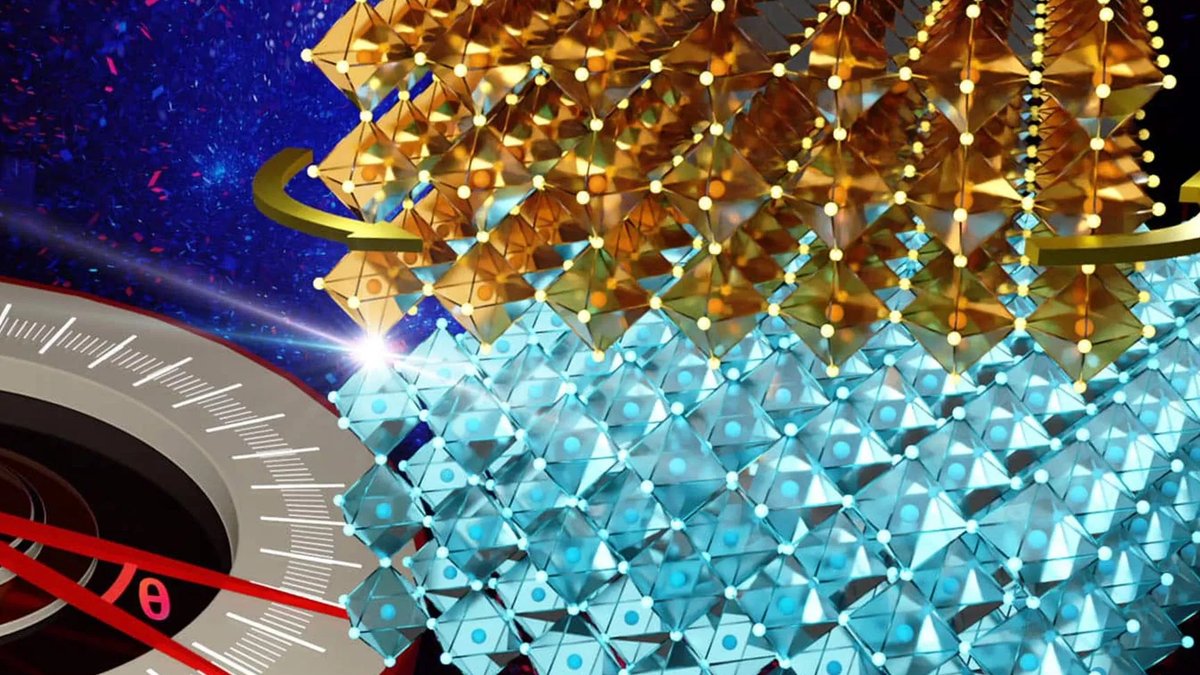
Researchers have made a significant breakthrough in the field of twistronics, developing a way to create twisted oxide materials over large areas while maintaining precise control over the rotation of their layers.
Twistronics explores how rotating one layer of a two-dimensional material relative to another can change the material’s electronic behavior. Until now, much of the field has focused on extremely thin materials held together by relatively weak forces. The field of twistronics was developed using 2D materials that are bonded by weak van der Waals forces.
Ruijuan Xu, corresponding author of a paper on the work and an assistant professor of materials science and engineering at North Carolina State University, says their work demonstrates it is possible to use layers of oxide materials that are connected by strong chemical bonds – while precisely controlling the twist angle between crystalline oxide membranes.
The team produced crystalline sodium niobate membranes and used photolithography to add visual reference markers around the edges of each membrane. They then lifted one membrane and positioned it on top of a second membrane, carefully setting the rotation angle between the two layers by watching how the reference markers lined up during assembly.
Related: Cutting protein may slow aging study suggests
Scale matters for devices, says Xu, because these crystalline membranes can be fabricated over large areas and transferred onto different supports, providing a practical path toward twist-engineered oxide electronics. After reaching the desired orientation, the team used an annealing process designed specifically for the material, forming strong chemical bonds between the stacked membranes.
The scientists used synchrotron X-ray diffraction to examine the boundary where the two oxide layers meet. The measurements revealed that the strong bonding between the membranes distorts the atomic structure of the material, creating a gradual rotation of the atomic lattice at the interface between the layers.
Xu notes that the experiment used sodium niobate as a model system, but they say the same method may also work with other complex oxide materials. Their work demonstrates a technique for creating large-area oxide twistronic materials with controlled twist angles and a strong chemical bond between layers.
It’s an exciting time for oxide twistronics, with new opportunities to engineer complex oxide functionalities through twist. As they continue to explore the potential of twistronics, they may uncover new ways to design materials and devices tailored to specific applications.
Related: Pull-Up Setup Tips Build Back and Biceps Strength
The strong interlayer bonding found between oxide layers suggests there may be entirely new interfacial phenomena to explore, and the ability to control many of the materials’ characteristics offers new routes for designing materials and devices. This advance could bring twistronics closer to practical electronic devices by giving scientists greater control over both the scale and internal structure of these materials.
The paper, “Deterministic Fabrication of Large-Area, High-Crystallinity Oxide Moiré Superlattices,” is published in the journal ACS Nano.
While the full effects of the structural changes on the material’s electronic and physical behavior remain to be seen, the researchers’ findings could eventually influence the material’s properties.
The team’s discovery is a significant step forward.


Leave a Reply