
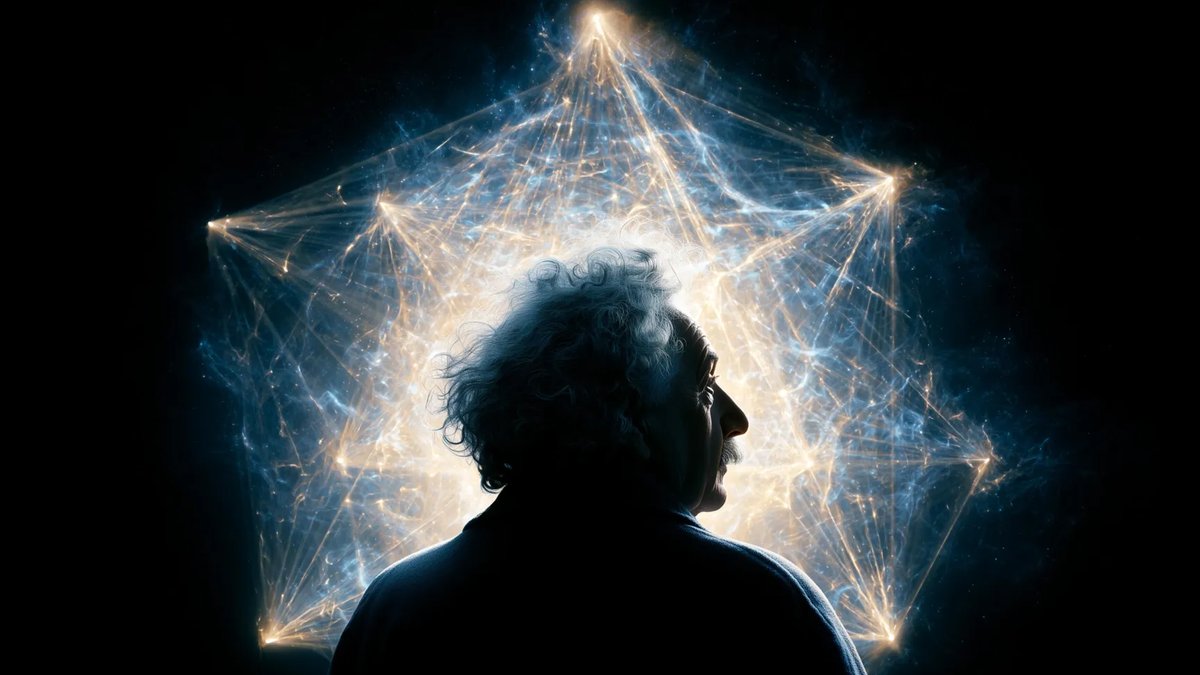
A little more than a century ago, Albert Einstein turned his attention from gravity itself to the fate of the entire universe. In 1917, shortly after developing his general theory of relativity, he began applying his new equations to cosmology. General relativity had transformed our understanding of gravity, so it made sense to apply those same equations to the universe on the largest possible scales.
Gravity was the natural place to start. On average, the universe is electrically neutral, which means electromagnetism does not dominate its large-scale behavior. Einstein also knew nothing about the strong and weak nuclear forces, but those interactions only operate over very short distances.
Einstein’s Unexpected Dynamic Universe
For cosmology, gravity determines how matter behaves across enormous distances. If you imagine a collection of matter representing “a universe,” Einstein’s equations can tell you how that collection should evolve. What Einstein found surprised him. General relativity did not naturally describe a universe that remained unchanged forever. Instead, the equations pointed toward a dynamic cosmos that would either expand or contract.
That conclusion conflicted with the prevailing view at the time, which held that the universe was static and had remained essentially the same throughout cosmic history. Einstein responded by adding a “cosmological constant” to his equations, represented by the Greek letter Lambda. General relativity already allowed such a term.
In simple terms, it acts like a gravitational influence built into spacetime itself, one that can exist even in otherwise empty space. Depending on its value, that effect can produce either attraction or repulsion. Einstein selected a value that counteracted the gravitational pull of matter, allowing the universe to remain stable.
An Expanding Universe Changes Everything
Within a few years, Edwin Hubble would discover that the universe is expanding. Meanwhile, theorists such as Russian cosmologist Alexander Friedmann took Einstein’s equations more literally and developed the theoretical foundation that would help support the Big Bang theory. Einstein eventually abandoned the cosmological constant. He would later tell friends that introducing it had been his “greatest blunder.”
Related: DNA memory breakthrough slashes power use
Then came another major surprise. Fast forward to 1998. Two teams of astronomers were trying to resolve a long-running disagreement over how much matter the universe contained. Different observations had produced very different estimates, with some suggesting there was relatively little matter and others indicating much more.
Astronomers already knew that the universe was expanding. Because matter produces gravity, however, that matter should have been gradually slowing the expansion. By measuring how strongly the expansion was decelerating, researchers hoped to determine how much matter was actually out there. Instead, they discovered the opposite.
The expansion of the universe was not slowing. It was accelerating. The observations still indicated that the universe contained relatively little matter, but even that matter was not enough to explain what astronomers were seeing. Something appeared to be pushing cosmic expansion to proceed faster over time.
Dark Energy Reshapes Modern Cosmology
The simplest explanation was a familiar one: Einstein’s cosmological constant. A constant background effect that produces cosmic repulsion could account for the observed acceleration. Decades after Einstein had discarded the idea, his supposed mistake returned as the leading explanation for the new data.
During the 1980s and 1990s, cosmologists had developed an increasingly sophisticated framework that became known as the Standard Model of Cosmology. But the discovery that cosmic expansion was accelerating meant that model could no longer stand in its existing form. Its replacement became our current best description of how the universe has evolved since the Big Bang: LCDM cosmology.
The Lambda refers to the cosmological constant, which is also known as dark energy. CDM stands for cold dark matter, the type of matter believed to account for most of the mass in nearly every galaxy. Cold dark matter is a story of its own. Here, the focus is Lambda.
Related: New Brain Rhythm May Improve Parkinson’s Treatment
LCDM has been extraordinarily successful. It is also surprisingly simple, relying on only a handful of adjustable parameters and a small number of assumptions within the framework of general relativity. Despite that simplicity, the model can account for an enormous range of observations.
It describes the expansion history of the universe, the appearance of background radiation, the mysterious star explosions, the growth of galaxies, the development of large-scale cosmic structure, and much more. LCDM has become one of the most thoroughly studied and extensively tested theories in all of science.
And it is almost certainly wrong. The success of LCDM is a result of human ingenuity, but it also highlights the limitations of our current understanding. As scientists continue to refine their models and gather new data, they may uncover even more surprising secrets about the universe.
One thing is clear: the universe is still full of mysteries waiting to be uncovered. The discovery of dark energy and the development of LCDM cosmology have opened up new avenues of research, and scientists are eager to explore them. As they do, they may find that the universe is even more complex and fascinating than they ever imagined.
Scientists are making new discoveries.


Leave a Reply