
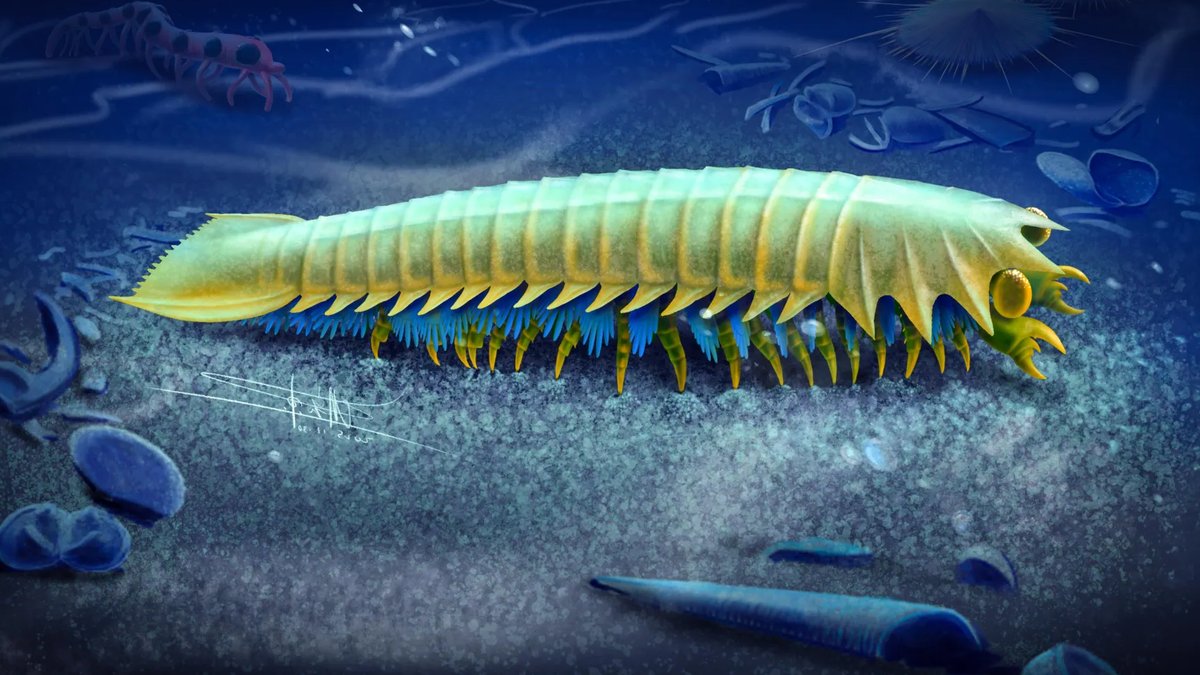
The earliest known evidence of structures that later became spider fangs has been found in a 518-million-year-old fossil, moving back the origins of these hunting tools by hundreds of millions of years.
An Ancient Marine Creature Holds the Key
The discovery involves Urokodia, a small marine animal from the early Cambrian Period. Measuring only 2-3 centimeters long, the creature looked nothing like modern spiders or scorpions, though it shared the same evolutionary lineage.
Urokodia had large, stalked eyes at the front of its body, a segmented skeleton, and jointed limbs beneath its narrow frame. Its fossils came from the Chengjiang fossil site in China’s Yunnan Province, one of the most important deposits of early animal life.
A study in Nature coincides with the 42nd anniversary of the site’s discovery.
Related: How Bioengineered Gum Cuts HPV and Cancer Risk by Up to 93%
X-Rays Expose Hidden Anatomy
Scientists from Yunnan University and the University of Leicester used X-ray tomography to examine the fossil encased in rock. The scans uncovered preserved soft tissue, an unusual find in specimens this old.
The most notable detail was a pair of pincer-like appendages near the creature’s eyes. These structures, the team determined, were early versions of chelicerae, the limbs that evolved into spider fangs and scorpion pincers.
The fossil also showed features on Urokodia’s legs that may have worked as book gills, respiratory organs still used by horseshoe crabs. This indicates the animal was fully adapted to underwater life, long before its descendants moved to land.
A Predatory Lineage Emerges
Chelicerates—spiders, scorpions, ticks, and their relatives—now include over 100,000 described species. They live in nearly every environment, from deep oceans to deserts. Their success as hunters, the study shows, began with ancestors like Urokodia, which were already active predators hundreds of millions of years ago.
Most chelicerates do not harm humans. Their venom and fangs developed to catch prey much smaller than people, though stories and films have exaggerated their danger—from the Black Widow to Spider-Man.
Related: Ancient city defies historical rules
Yu Liu, a professor at Yunnan University who led the research, recalled the discovery: “We were analyzing these fossils with X-ray tomography to uncover their soft anatomy hidden in the rocks for hundreds of millions of years when we spotted the pincer-like limbs at the front. We realized immediately this was a significant find and a distant ancestor of today’s chelicerates like scorpions and spiders.”
The Chengjiang site preserves a snapshot of a busy marine ecosystem from over 500 million years ago. More than 200 species have been identified there, offering a rare view of early complex life.
Mark Williams, a co-author from the University of Leicester, said the fossils offer “a rare view of early complex life.”
Urokodia’s lineage had already left its mark. The findings suggest how these small creatures set the stage for one of nature’s most adaptable groups. Their influence appears not just in spider fangs or scorpion stings but in the lasting design that has endured for half a billion years.


Leave a Reply