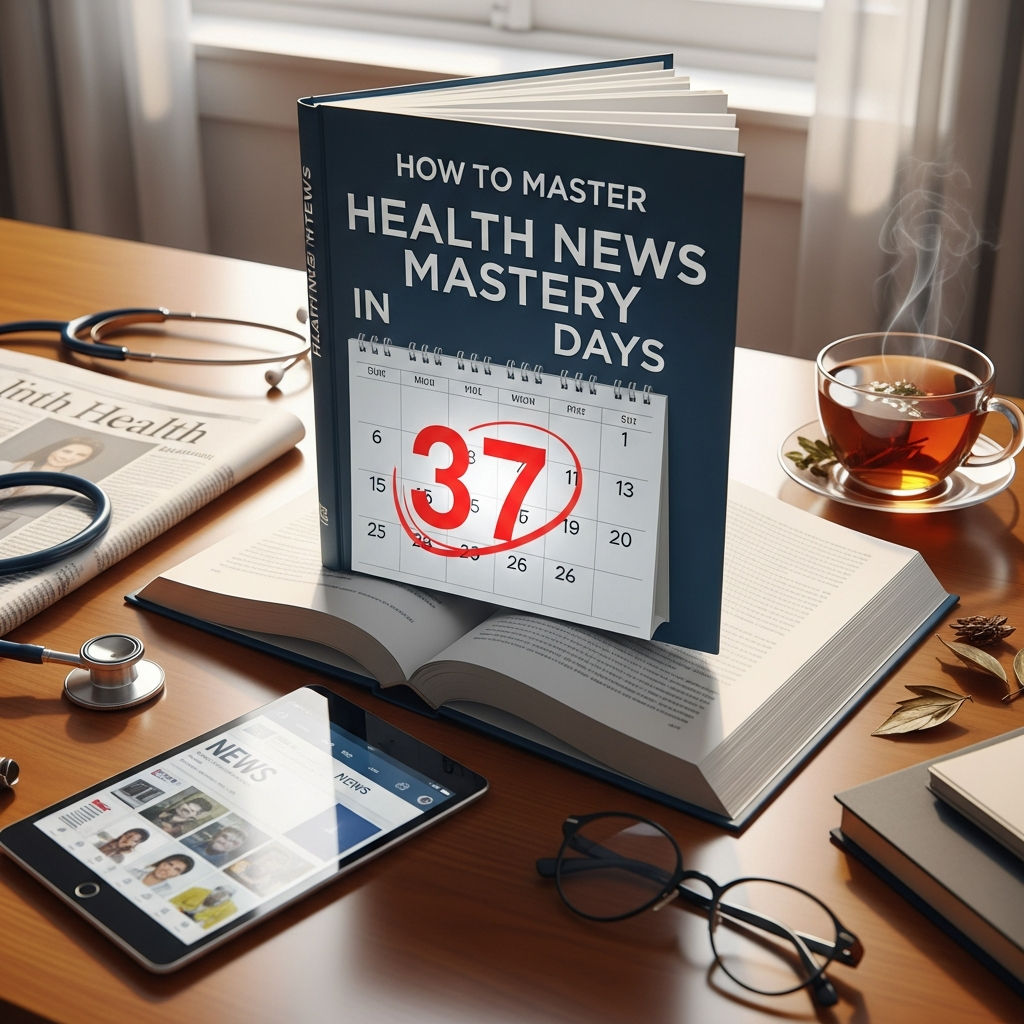
How to Master Health News in 37 Days: A Complete Guide to Health Literacy
In an era where information is abundant but clarity is scarce, the ability to navigate health news is a vital life skill. Whether you are a biohacker looking for the latest longevity protocols or a concerned parent trying to understand nutritional guidelines, the “noise” of the internet can be deafening. Sensationalist headlines often distort complex medical findings, leading to confusion and, in some cases, harmful health choices.
Mastering health news isn’t about becoming a doctor in a month; it is about developing health literacy. It is the ability to find, understand, and use information to make informed decisions. This 37-day roadmap is designed to transform you from a passive consumer of clickbait into a discerning critic of medical information.
Phase 1: Building Your Foundation (Days 1–7)
The first week is dedicated to cleaning up your digital environment and identifying where your information comes from. Most people consume health news through social media algorithms, which prioritize engagement over accuracy.
Day 1–3: Vetting Your Sources
Start by auditing your current information sources. If your health news comes primarily from TikTok or Facebook, you are at risk of encountering misinformation. During these three days, bookmark the “Gold Standard” sources:
- Peer-Reviewed Journals: The Lancet, The New England Journal of Medicine (NEJM), and Nature.
- Government Institutions: The CDC, NIH, and the NHS.
- Educational Aggregators: PubMed and Google Scholar.
- Independent Review Sites: Examine.com (for supplements) and Cochrane Library (for systematic reviews).
Day 4–7: Mastering the RSS and Newsletter Curation
Stop waiting for news to find you. Use tools like Feedly or OldReader to subscribe to the “Press Release” or “News” sections of major medical universities like Harvard Health or Johns Hopkins. This ensures you see the primary source of a story before it gets filtered through mainstream media outlets that might add a sensationalist spin.
Phase 2: Decoding the Science (Days 8–21)
To master health news, you must speak the language of science. This two-week phase focuses on understanding how a study is structured and what the terminology actually means.
Day 8–12: Understanding the Hierarchy of Evidence
Not all studies are created equal. Spend these days learning the “Pyramid of Evidence.” At the bottom, you have animal studies and case reports; while interesting, they rarely justify changing your lifestyle immediately. In the middle are Randomized Controlled Trials (RCTs), and at the top are Systematic Reviews and Meta-analyses. When you read a headline, your first question should be: “What kind of study was this?”
Day 13–17: Correlation vs. Causation
This is the most common trap in health journalism. A headline might say, “Coffee Drinkers Live Longer.” This is a correlation. It does not mean coffee causes longevity; it might just be that coffee drinkers tend to have higher incomes or more social interactions. Mastering this distinction will prevent you from chasing every new “superfood” trend.
Day 18–21: The Power of the Abstract and the “Conflict of Interest”
Learn to read a scientific abstract. It contains the Objective, Methods, Results, and Conclusion. More importantly, scroll to the bottom of any study to look for the “Disclosures” or “Conflicts of Interest.” If a study claiming sugar is harmless was funded by the beverage industry, you need to view those results through a skeptical lens.
Phase 3: Diversifying and Refining Your Feed (Days 22–30)
Now that you have the technical skills, it is time to broaden your horizons and understand the nuances of different health niches.
Day 22–25: Exploring Specializations
Health news isn’t just about “general wellness.” Spend these days focusing on specific sectors that interest you, such as:
- Nutritional Science: Learn about the “Healthy User Bias.”
- Mental Health: Understand the difference between clinical significance and statistical significance.
- Longevity and Genetics: Follow the work of reputable researchers rather than influencers.
Day 26–30: Identifying “Health Influencer” Red Flags
By day 30, you should be able to spot a “health guru” selling a shortcut. Be wary of anyone who uses “absolute” language (e.g., “This one vegetable is killing you”) or anyone who cites a single study to disprove decades of established science. Real health news is usually nuanced, cautious, and boring.
Phase 4: Integration and Critical Analysis (Days 31–37)
The final week is about putting your knowledge into practice and ensuring that your new habit is sustainable for the long term.
Day 31–34: The “Deep Dive” Practice
Pick one trending health story. Trace it back from the news article to the original press release, and finally to the actual study published in a journal. Compare the headline to the study’s “Limitations” section. Often, you will find that the study was conducted on mice or a very small group of people, yet the headline generalized the results to everyone.
Day 35–37: Building a Consultative Relationship
The ultimate goal of mastering health news is to be a better partner to your healthcare provider. Use these final days to organize your findings. When you see a piece of news that seems relevant to your health, don’t self-diagnose. Instead, print the study (or the summary) and bring it to your next doctor’s appointment. Ask, “How does this data apply to my specific biomarkers?”
Why 37 Days Matters
You might wonder why 37 days? Research suggests that while it takes about 21 days to form a simple habit, complex cognitive habits—like critical thinking and source verification—require more time to become “automatic.” By pushing past the one-month mark, you are cementing these skills into your daily routine. You are moving from “searching for answers” to “evaluating evidence.”
The Dangers of Misinterpreting Health News
The stakes are high. Misinterpreting a study on heart health might lead someone to stop a necessary medication. Misunderstanding nutritional data might lead to restrictive eating patterns that cause deficiencies. By following this 37-day plan, you protect yourself against the “infodemic” and gain the confidence to manage your own well-being.
Common Pitfalls to Avoid
- Confirmation Bias: Only looking for news that supports what you already believe (e.g., searching for “benefits of keto” while ignoring “risks of keto”).
- The “Miracle Cure” Syndrome: Believing that a single discovery will solve a complex, multi-factorial disease.
- Over-reliance on AI: While AI can summarize papers, it can also “hallucinate” or miss the subtle context of a medical discussion. Always verify with the source.
Conclusion: The Lifelong Journey of Health Literacy
After 37 days, you will find that you spend less time reading sensationalist news and more time reading quality synthesis. You will find yourself looking for the “N” (sample size) of a study and checking the “P-value” (statistical significance). You will become a more informed patient, a more skeptical consumer, and a more resilient individual.
Mastering health news is not a destination; it is a continuous process of unlearning and relearning. Science is self-correcting, and our understanding of the human body changes every day. With the framework you have built over the last 37 days, you are now equipped to change with it, safely and intelligently.